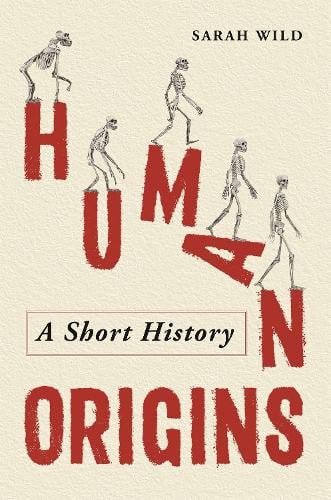
 Human Origins: A Short Story
Sarah Wild (Michael O’Mara, 2023)
Humans are the dominant species on the planet. But how did we get here? Human Origins takes the reader on a fascinating 7-million-year journey from our earliest primordial ape-like roots through to the present day.
For almost a hundred years, scientists have been trying to decipher the secrets of humanity’s evolution. At first, they relied on rare pieces of ancient skulls and bone fragments. But every year, they make new discoveries, uncover new fossils and develop new techniques to tease apart the story of our evolution.
So far, from skeletons to teeth, humanity has found more than 6,000 hominin individuals. These individuals span several species, all of which tell the tale of human evolution: how our brains changed over time, what we ate, how we lived. Including the latest scientific findings, Human Origins will also look at some of the biggest questions that remain: What makes humans unique? Where did the Neanderthals go? And are humans still evolving? Buy Human Origins here.
South Africa’s Survival Guide to Climate Change
Sipho Kings and Sarah Wild (PanMacMillan South Africa, 2019)
This is a survival guide. It rests on the idea that we could possibly survive a changing climate.  Temperatures are already climbing, sea levels are rising and parts of South Africa are on their way to being uninhabitable.
Life is already incredibly hard for many people and nobody will be exempt from climate change. Circumstances are going to get a lot more difficult very soon, and we need a plan. This is a practical handbook that explores what climate change is likely to mean for us as South Africans, how we can prepare for it, and how we can – in our everyday lives – help to mitigate the impacts it will have. Buy South Africa’s Survival Guide on Amazon here.
Innovation: Shaping South African through science
Sarah Wild (PanMacMillan South Africa, 2015)
If you mention ‘South Africa’ and ‘innovation’ in a sentence together, people will nod their heads wisely and say, ‘Ah yes. Pratley Putty. Do you know that it is the only South African product to have travelled to the moon?’ While Pratley Putty has pride of plac e alongside duct tape as one of the world’s more useful adhesives, it was developed in the 1960s. Or the Kreepy Krauly, an automatic pool-cleaning device that is now sold all over the world … which was first sold in the 1970s. ‘Of course South Africans are innovative – Christiaan Barnard performed the world’s first heart transplant,’ people say. But that was in 1967. What are we doing in 2015?
Innovation is a celebration of the science and innovation happening in South Africa right now, addressing real problems on the ground and helping people in South Africa to live healthier, happier lives. It looks at inventions – developed locally by South Africans – to address issues in the areas of environment, energy, health, industry and education. Some of these inventions, such as genetic research for personalised medicine, can save lives; others, such as a unique way to beneficiate titanium, could spell a new era of industry in the country. All of these innovations illustrate our current scientific advances and developments and showcase South Africa’s potential for excellence. Buy Innovation on Amazon here.
Searching African Skies: The Square Kilometre Array and South Africa’s quest to hear the songs of the skies
Sarah Wild (Jacana, 2012)
An ambitious scientific project is unfolding in the desert of South Africa, with a multi-decade time line that will eventually see expansion into Western Australia—a project that is detailed  and celebrated in this book on the Square Kilometre Array (SKA). The SKA will be the largest and most sensitive radio telescope, expanding the capabilities of scientific probing and addressing significant unanswered questions about the universe, such as the formation of galaxies and the nature of gravity.
Science writer Sarah Wild covers the important development with this exploration of its implications on an international scale as well as its South African context, from the first telescope built in the country in the 1960s to Xhosa starlore. Interspersed with |Xam bushmen stories rewritten from original manuscripts, this consideration is an informed and thoughtful insight into an exciting step in astronomy. Buy Searching African Skies here.